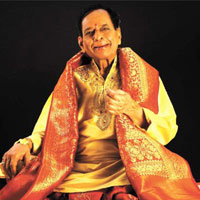
Dr. Mangalampalli Balamurali Krishna (6 July 1930 – 22 November 2016) was a legendary Indian Carnatic vocalist, musician, multi-instrumentalist, playback singer, composer, and character actor who revolutionized Carnatic music through his innovative approach while preserving its rich traditions. Widely regarded as one of the greatest musicians of the 20th century, he was a child prodigy who became a towering figure in Indian classical music.
Early Life and Musical Prodigy
Born in Sankaraguptam, East Godavari District, Andhra Pradesh, Balamurali Krishna came from a deeply musical family. His father Pattabhiramayya was a skilled player of the flute, violin, and veena, while his mother Sooryakantamma, daughter of the renowned composer Prayaga Rangadasu, was an excellent veena player. After his mother's death when he was an infant, he was raised by his father who recognized his exceptional musical talent early on.
Musical Training and Early Career
Observing his profound interest in music, his father placed him under the tutelage of Parupalli Ramakrishnayya Pantulu, a direct descendant of the shishya parampara of Saint Tyagaraja. Under this guidance, young Balamurali Krishna learned the fundamentals of Carnatic music. At the remarkable age of eight, he gave his first full-fledged concert at a Thyagaraja Aradhana in Vijayawada. Musunuri Suryanarayana Murty Bhagavatar, a Harikatha performer who witnessed his extraordinary talent, bestowed the prefix "Bala" (meaning child) to honor the young prodigy.
Extraordinary Musical Achievements
By the age of fifteen, Balamurali Krishna had mastered all 72 melakartha ragas and composed krithis in each of them - a feat unprecedented in Carnatic music history. His "Janaka Raga Manjari" was published in 1952 and recorded as "Raagaanga Ravali" in a nine-volume series by the Sangeeta Recording Company. This early achievement established him as not just a performer but also as a composer of exceptional caliber.
Multi-Instrumental Mastery
Not content with vocal excellence alone, Balamurali Krishna became proficient in multiple instruments including kanjira, mridangam, viola, violin, veena, and flute. He regularly accompanied various musicians on violin and was noted for giving solo viola concerts. This multi-instrumental expertise made him unique among Carnatic musicians and demonstrated his comprehensive understanding of music from multiple perspectives.
Prestigious Awards and Recognition
His contributions to music earned him numerous prestigious honors:
- Padma Vibhushan (1991) - India's second-highest civilian honor
- Sangeetha Kalanidhi (1978) - Madras Music Academy's highest honor
- Two National Film Awards (1976, 1987) - For classical music and playback singing
- Sangeet Natak Akademi Award (1975)
- Mahatma Gandhi Silver Medal from UNESCO (1995)
- Chevalier of the Ordre des Arts et des Lettres (2005) - French Government
- Sangeetha Kalasikhamani (1991) - Fine Arts Society, Chennai
Global Concert Career
Throughout his lifetime, Balamurali Krishna gave over 25,000 concerts worldwide, performing in countries including the United States, Canada, United Kingdom, Italy, France, Russia, Sri Lanka, Malaysia, Singapore, and Middle Eastern nations. His concerts masterfully combined sophisticated vocal skills and rhythmic patterns of classical music with entertainment value, making Carnatic music accessible to diverse audiences globally.
Collaborative Performances
He presented memorable jugalbandi concerts (duets) with legendary Hindustani musicians including Pandit Bhimsen Joshi, Pandit Hariprasad Chaurasia, Pandit Ajoy Chakrabarty, and Kishori Amonkar. These collaborations showcased his versatility and ability to bridge different musical traditions while maintaining the integrity of each style.
Compositional Genius
Balamurali Krishna composed over 400 pieces encompassing every facet of Carnatic music including Varnas, Krithis, Thillanas, and Bhavageethas. His compositions span multiple languages including Telugu, Sanskrit, Tamil, Malayalam, Kannada, Hindi, Bengali, and Punjabi. He is one of the very few musicians to have composed in all 72 Melakarta Ragas, demonstrating his comprehensive mastery of the Carnatic system.
Musical Innovations
A true innovator, he created several new ragas including Ganapathi, Sarvashri, Mahati, Lavangi, and others, representing his quest for new musical frontiers. He also invented a new Tala system, contributing to the theoretical framework of Carnatic music. His innovations enriched the tradition while maintaining its classical foundation.
Preservation of Musical Heritage
He played a crucial role in popularizing the compositions of Sri Bhadrachala Ramadasu and Sri Annamacharya, bringing these devotional treasures to contemporary audiences. His clear diction in multiple languages led to an invitation to record Tagore's entire Rabindra Sangeet compositions in Bengali, preserving them for posterity.
International Collaborations
Balamurali Krishna appeared as featured soloist with an award-winning British choir, performing the "Gitanjali Suite" with words from Rabindranath Tagore's Nobel Prize-winning poetry. He sang in French and even ventured into jazz fusion, collaborating with top Carnatic percussion teacher Sri T.H. Subash Chandran in concerts for Malaysian royalty, demonstrating his musical versatility.
Film Career and Playback Singing
Beyond classical music, he dominated South Indian cinema for many years as both a playback singer and character actor. He is the only musician to win National Awards in India for classical music, music direction, and film playback singing, showcasing his versatility across different musical domains.
Teaching and Musical Philosophy
His approach to music combined rigorous classical training with innovative expression. He believed in breaking conventional boundaries while respecting tradition, inspiring countless musicians to explore new possibilities within the classical framework. His concerts were known for their spontaneity and creative improvisation.
Legacy and Impact
Dr. Mangalampalli Balamurali Krishna passed away on 22 November 2016, leaving behind an unparalleled legacy in Carnatic music. His contributions as a performer, composer, innovator, and cultural ambassador have permanently enriched the world of Indian classical music. He demonstrated that tradition and innovation could coexist harmoniously, inspiring future generations to push the boundaries of classical music while honoring its sacred foundations. His life's work continues to influence musicians worldwide, cementing his position as one of the greatest musical geniuses in Indian history.