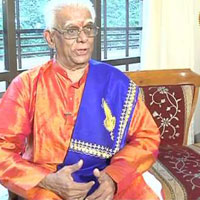
Professor S. Rangasamy Janakiraman (born July 12, 1928) is a distinguished Carnatic vocalist, musicologist, and educator who represents one of the last living links to the golden era of Carnatic music. Born in Lalgudi, Tamil Nadu, he is perhaps the oldest living disciple of legendary masters including Tiger Varadachariar, Musiri Subrahmanya Iyer, Tiruppampuram Swaminatha Pillai, and T. Brinda. His unique combination of scholarly knowledge and practical expertise has made him a revered figure in both performance and academic circles, earning him the highest honors in Indian classical music including the Sangeet Natak Akademi Fellowship and Padma Shri.
Early Life and Musical Foundation
Born on July 12, 1928, in Lalgudi, Tamil Nadu, to Rangaswami Iyer and Gowri Ammal, Janakiraman was introduced to Carnatic music at the age of 10 in 1938. His initial training began under Thanneerpalli Krishnamurthi at Trichirapalli, where he learned several fundamental compositions and developed his basic musical skills.
Training at Kalakshetra and Legendary Gurus
His major breakthrough came in 1945 when he joined Kalakshetra, where he received training from some of the most illustrious names in Carnatic music:
- Tiger Varadachariar - The legendary vocalist and musicologist
- Budalur Krishnamurthy Sastri - Renowned for his scholarly approach
- T.K. Ramasami Ayyangar - Expert in traditional compositions
- Kalpagam Swaminathan - Master of classical repertoire
- Musiri Subrahmanya Iyer - The great vocalist known for his style
- T. Brinda - The legendary female vocalist
- Tiruppamburam Swaminatha Pillai - Master of traditional music
Academic Training in Musicology
Beyond performance, Janakiraman received rigorous training in musicology from distinguished scholars:
- Prof. P. Sambamoorthy - The renowned musicologist and author
- P.K. Rajagopala Iyer - Expert in music theory and analysis
This dual training in both practical music and theoretical knowledge positioned him uniquely as both performer and scholar.
Academic Career and Educational Leadership
Janakiraman began his teaching career at Madanapalli and Tirupati in Andhra Pradesh, eventually heading the Department of Musicology at Sri Venkateswara College of Music, Tirupati. He taught music for over 33 years, shaping generations of musicians and musicologists. After retirement, he continued as a research scholar and served on the experts committee at the Madras Music Academy. He also served as Principal at the Teachers College of Music, following in the footsteps of his guru.
Unique Performance Style and Repertoire
Janakiraman is renowned for his lecture demonstrations and unique presentation style that combines deep knowledge of lakshana (musical theory) with the ability to practically demonstrate complex concepts. His repertoire is exceptionally wide and varied, including:
- Rare and complex tana varnas
- Rarer compositions of Muttuswami Dikshitar and Subbarama Dikshitar
- Compositions of Annamacharya
- Ancient and medieval ragas
- Vivadi ragas - Following his teacher Tiger Varadachariar's belief in resurrecting ancient ragas
Scholarly Approach to Ancient Music
Like his teacher Tiger Varadachariar, Janakiraman belongs to the school of musicians who believe that ancient and medieval ragas can be successfully resurrected. He does not subscribe to the notion of vivadi dosha (dissonance defect) and includes several vivadi ragas as part of his repertoire, demonstrating his commitment to preserving the complete spectrum of Carnatic music tradition.
Prestigious Awards and Recognition
His contributions to Carnatic music have been recognized with the highest honors:
- Sangeet Natak Akademi Fellowship - The highest performing arts award conferred by the Government of India
- Padma Shri (2011) - India's fourth-highest civilian honor
- Sangeet Natak Akademi Award - National recognition for excellence in performing arts
- Sangita Kala Acharya - The Music Academy, Chennai
- Kalaimamani - Tamil Nadu Government
- Ganamruta Kalaratna - Kendra Sangeet Natak Akademi
Research and Scholarly Contributions
As a musicologist, Janakiraman has made significant contributions to the theoretical understanding of Carnatic music. His work on the experts committee at the Madras Music Academy has helped shape academic standards and preserve traditional knowledge. His research has focused on ancient ragas, traditional compositions, and the scientific aspects of Carnatic music theory.
Educational Impact and Teaching Philosophy
Through his decades of teaching at Sri Venkateswara College of Music, Janakiraman has trained numerous musicians and musicologists who have gone on to make their own contributions to the field. His approach combines rigorous theoretical knowledge with practical demonstration, making complex musical concepts accessible to students.
Preservation of Musical Heritage
As one of the last living disciples of the great masters of the early-to-mid 20th century, Janakiraman serves as a crucial link to the golden era of Carnatic music. His knowledge of rare compositions, ancient ragas, and traditional performance practices makes him an invaluable repository of musical heritage.
Continuing Legacy at 96
Having celebrated his 90th birthday in 2018, Professor Janakiraman continues to be active in the musical community, sharing his vast knowledge through lectures, demonstrations, and guidance to younger musicians. His longevity and continued engagement with music make him a living treasure of Carnatic music tradition.
Contribution to Musical Literature
His scholarly work includes contributions to musical literature and educational materials that help preserve and transmit traditional knowledge. His expertise in both practical and theoretical aspects of music has made his writings and teachings invaluable resources for students and researchers.
Legacy and Influence
Professor S.R. Janakiraman represents the ideal synthesis of performer and scholar in Carnatic music. His life's work demonstrates how deep theoretical knowledge can enhance practical musicianship, and how scholarly research can serve the cause of preserving and propagating classical traditions. As a direct link to the great masters of the past and a mentor to contemporary musicians, he embodies the continuity of the guru-shishya parampara. His contributions ensure that the knowledge, repertoire, and performance practices of Carnatic music's golden era continue to be available to future generations, making him an indispensable figure in the preservation and evolution of Indian classical music.