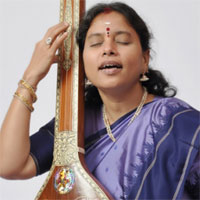
Dr. Saraswati Vidyardhi (born 1 May 1963) is a distinguished Carnatic vocalist, composer, researcher, and educator from Andhra Pradesh, India. She has gained critical acclaim for her groundbreaking research in Anumandra sthai (octave) and her unique ability to sing notes below the mandra shadjam up to the anumandra shadjam. A pioneering figure in Carnatic music research, she has also unearthed rare Panchamantya ragas, contributing significantly to the preservation and expansion of Carnatic musical knowledge.
Early Life and Musical Foundation
Born in Kolkata into a family of musicians, Saraswati was immersed in music from an early age. She received her basic musical training from her father Sri I.V.L. Sastry, the founder of Sangeetha Janakulam, a music school that offered free coaching to students. This early exposure to both performance and pedagogy would later influence her own approach to music education and research.
Advanced Training and Mentorship
She later became the disciple of Sri Ivaturi Vijayeswara Rao, a versatile musician of excellent reputation who further developed her musical skills. For over two decades, she has been under the tutelage of the renowned Dr. Nedunuri Krishnamurthy, whose influence has been instrumental in shaping her artistic and scholarly approach to Carnatic music.
Academic Achievements
Dr. Vidyardhi holds an MA in Music from Andhra University and was awarded a PhD in Music for her comprehensive thesis titled "The Unique Style and Personality of 'Padmabhushan', 'Sangita Kalanidhi' Dr Sripada Pinakapani." This doctoral work demonstrates her deep scholarly engagement with the lives and contributions of Carnatic music legends.
Groundbreaking Research Contributions
Her most significant contribution to Carnatic music lies in her intensive research on Anumandra sthai (octave). She possesses the rare ability to sing notes below the mandra shadjam up to the anumandra shadjam, exploring musical territories that few vocalists have ventured into. Additionally, she has unearthed rare Panchamantya ragas, expanding the repertoire of available ragas for contemporary musicians and researchers.
Performance Career
Dr. Vidyardhi has performed at various prestigious festivals and venues across India in all major cities under the aegis of renowned Sabhas including The Music Academy, Sri Krishna Gana Sabha, Mudra, and Sri Shanmukhananda. She has also performed for the Spirit of Unity Concerts for National Integration and All India Radio's Sangeet Sammelan, showcasing her commitment to using music as a bridge for cultural unity.
Academic Leadership and Administration
From 2008 to 2014, she served as the Chairperson of the Board of Studies at Andhra University, demonstrating her leadership in academic music education. She has served as a selection committee member for several prestigious universities including Rajiv Gandhi University of Knowledge Technologies, Sri Padmavathi Mahila Visvavidyalayam, and Andhra University. Currently, she holds the position of Professor in the Department of Music at Andhra University and has been guiding research scholars for over a decade.
Scholarly Publications and Research
Dr. Vidyardhi has authored sixteen research papers and presented ten of them at various national and international seminars and conferences on music. Eight of her research papers have been published in reputed music journals, including the prestigious Journal of The Music Academy. She has chaired sessions at music conferences and served as a resource officer at several workshops, contributing to the academic discourse on Carnatic music.
Literary Contributions
She has published two books co-authored with her father: "Sri Tyagaraja Ghanaraga Pancharatna Krithimala" and "Sankeerthana Ratnavali." Her unpublished works include "Taana Deepika," "Sankeerthana Ratnakaram," and "Simhagiri Sankeerthanas," demonstrating her ongoing commitment to documenting and preserving Carnatic musical knowledge.
Discography and Musical Documentation
Her recorded works showcase both her performance skills and research interests:
- Varnamritham (2006) - Covering Dr. Sripada Pinakapani's Varnams with her daughter
- Karnamritham (2006) - Original devotional compositions
- Nadamritham (2009) - 2-hour concert in two discs
- Annamayya Sangeetha Sourabham (2012) - Forty compositions of Annamacharya set to tunes by Pinakapani, released on Pinakapani's 100th birthday
Awards and Recognition
Her contributions to Carnatic music have been recognized with numerous awards:
- AIR Music Competition Prize, Classical Vocals (1984)
- Gold Medal of the Visakha Music Academy (1984)
- Gold Medal – Ragam Tanam Pallavi Competition (1992)
- Gold Medal – Doorvasula Bhagavanlu Memorial (1992)
- Outstanding Young Artiste Award from Jaycees (1992)
- Outstanding Young Artiste Award from Visakha Music Academy (1997)
- Top Grade in Carnatic Music from Prasar Bharathi Broadcasting Corporation of India, New Delhi (2008)
Educational Impact and Lecture Demonstrations
Dr. Vidyardhi has given numerous lecture-demonstrations on Carnatic music, combining her performance skills with her scholarly knowledge to educate audiences about the intricacies of the art form. Her ability to explain complex musical concepts while demonstrating them practically has made her a sought-after speaker at music conferences and educational institutions.
Personal Life and Family
She is married to K. Eswara Chandra Vidyardhi and has a daughter named Lahari Kolachela, who has also been involved in her mother's musical projects, particularly in recording ventures that preserve and promote classical compositions.
Legacy and Continuing Influence
Dr. Saraswati Vidyardhi represents the modern scholar-performer in Carnatic music, successfully combining rigorous academic research with accomplished artistry. Her pioneering work in exploring the lower octaves of Carnatic music and her discovery of rare ragas have opened new avenues for both performers and researchers. Through her teaching, research, publications, and performances, she continues to contribute to the evolution and preservation of Carnatic music, ensuring that both traditional knowledge and innovative discoveries are passed on to future generations. Her work exemplifies how academic rigor and artistic excellence can complement each other in advancing the understanding and appreciation of classical Indian music.